
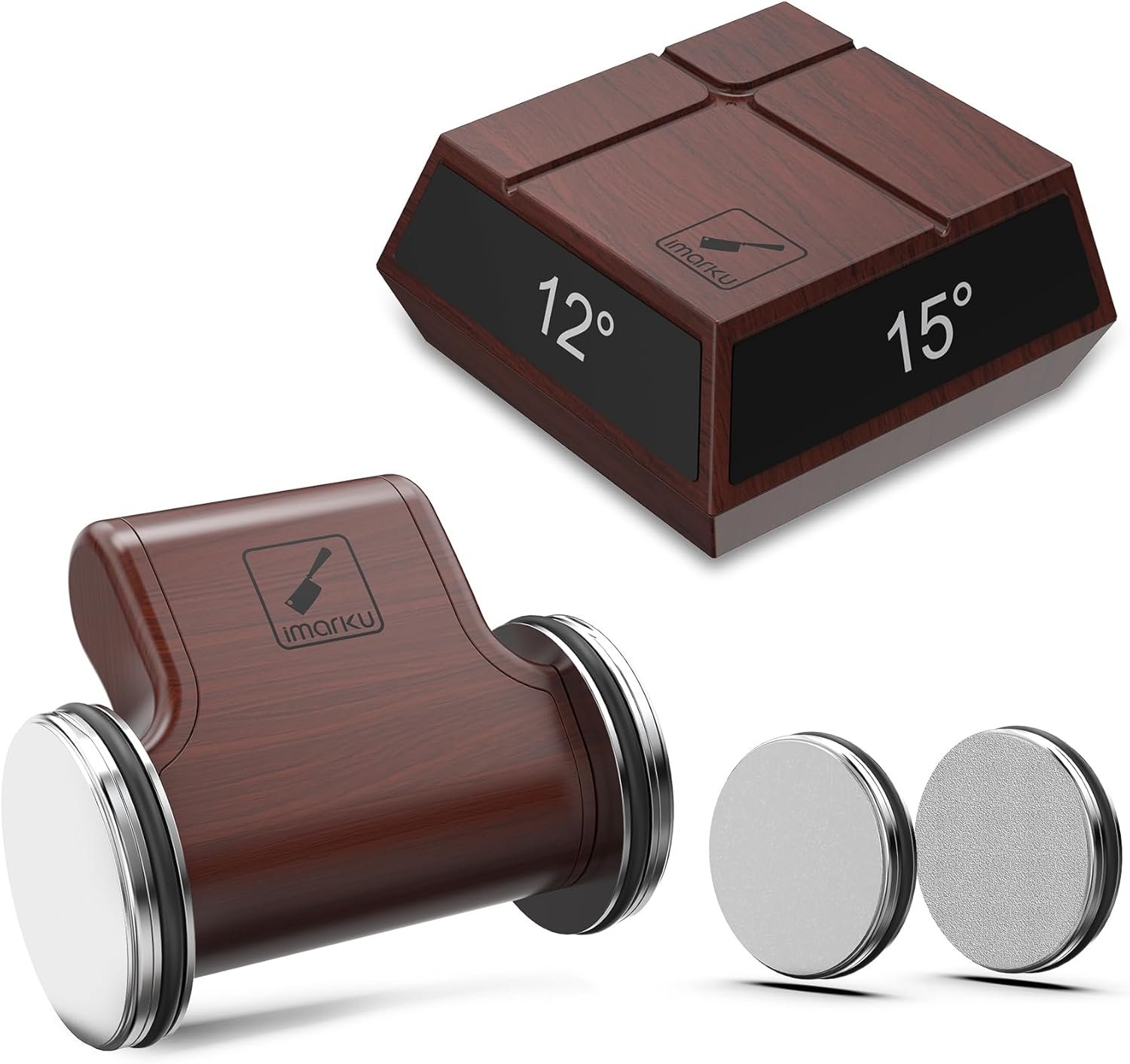


Imarku Knife Sharpener is a rolling-style knife sharpener that uses diamond discs and supports multiple preset sharpening angles. It’s designed for home use and aims to make professional-quality sharpening easier and more consistent without needing to master a whetstone or manual sharpening technique.
✅ What’s good
-
Adjustable angles — The sharpener offers four magnetic angle settings: 12°, 13°, 15°, and 20°, giving good flexibility depending on the type of knife and edge you want.
-
Lower angles (12°/13°) are suited for finer slicing tasks, e.g., thin Japanese-style knives.
-
The 15° setting seems the “everyday” sweet spot: good balance of sharpness + durability.
-
20° is offered for tougher, heavier-duty cutting tasks (more durability).
-
-
Diamond discs — According to the product description, it uses industrial-grade diamond grinding discs: a #400‐grit disc (38 µm) for more rapid material removal, and a #1000 disc (15 µm) for finer honing.
-
Diamond is a robust abrasive medium: good for harder steels, longer wear. The brand claims that this helps maintain edge longer.
-
-
Ease of use & safer design — The “rolling” design (rather than just a pull-through slot) plus the downward‐sharpening mechanism is marketed for safety and consistency (less skill needed to keep the angle).
-
The marketing and one user review say that the magnetic angle guide helps even beginners get a good result without worrying about “guessing the angle”.
-
One user review:
“After just a couple of passes, my knives went from dull to super sharp … I love how smooth the rolling design feels, and it takes away all the guesswork compared to other sharpeners I’ve tried.”
-
-
Versatility — Because of the multiple angles and diamond discs, it claims to cover a wide range of kitchen knives (chef’s knives, santoku, paring, etc.) and even tougher blades (via 20°).
⚠️ What to watch out (or possible drawbacks)
-
Price & value — The listed price on the official site is quite high (US$129.99 in one listing). For some home users, that may be a lot compared to simpler sharpeners or even traditional whetstones.
-
Build material / durability concerns — While it uses ABS plastic construction (according to the listing) for the body. ABS is reasonably durable, but heavy usage over time (especially with harder steels) may stress components, especially if you lean on it heavily. Maintenance/replacement of discs may be needed.
-
Learning / technique still matters — Even with guides, you still need to use it properly (blade positioning, consistent passes, ensuring the base is steady). The manufacturer mentions a tip: “Ensure the blade extends past the base’s center line to avoid contact with the roller base”.
-
Not ideal for all blade types — While it claims versatility, some special blades (very thin, ceramic, serrated) may not be well served. Also, if you have extremely high-end Japanese steel that’s meant for very fine angles (<12°) then this may not match professional whetstones. Also the 20° angle, while good for durability, may not give the extremely razor edge that some fine slicing tasks demand.
-
Storage / footprint / replacement parts — Larger sharpeners take up space; you’ll want to check how easy it is to replace discs, availability of spare parts/discs locally (in the Philippines). The brand claims the discs are detachable for replacement.
-
Risk of over-grinding / removing too much steel — With diamond discs you can remove metal quickly. If used without care, you might shorten the life of the knife edge by removing too much material or changing the bevel too much. Good for restoration, less ideal for light maintenance.

Reader reviews
No reader reviews yet. Our editorial rating is separate.