
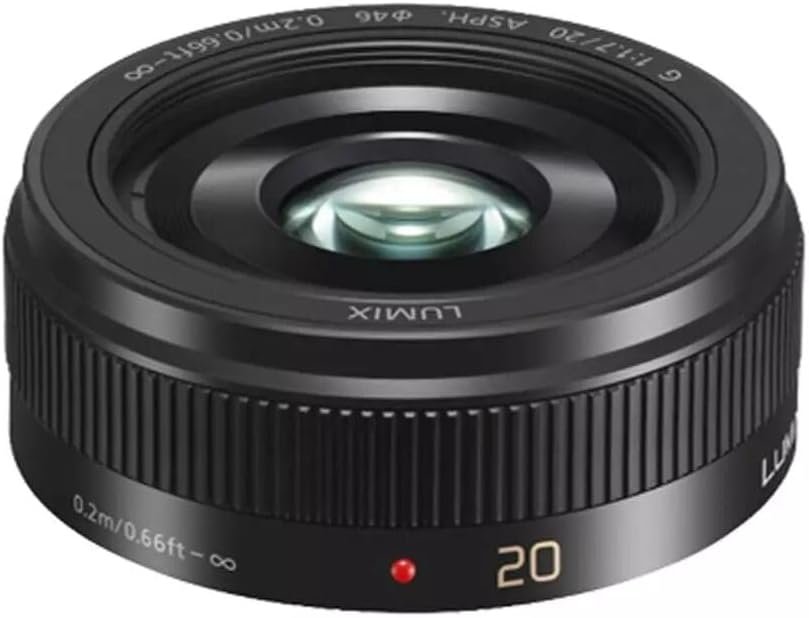


Panasonic Lumix 20mm f/1.7 Review: Small Lens, Big Appeal
The Panasonic Lumix 20mm f/1.7 makes a good case for keeping a Micro Four Thirds camera small. Its pancake design, bright aperture, and useful focal length make it appealing for travel, street photography, food, and everyday pictures.
But there is a catch: the autofocus is showing its age.
✅ Pros
📸 Sharp images from a tiny lens
Image quality is its strongest selling point. Independent testing found excellent centre sharpness, including at f/1.7, so shooting wide open does not mean giving up crisp detail on your subject.
👜 Compact and lightweight
The original weighs approximately 100g, while the Mark II weighs approximately 87g. Both are around 25.5mm long, keeping your camera easy to carry without a bulky lens sticking out.
🌙 Bright f/1.7 aperture
Useful indoors, in restaurants, and after sunset. Compared with a slower lens, the wider aperture lets you use a faster shutter speed or lower ISO under the same lighting conditions.
👀 Versatile 40mm-equivalent view
On Micro Four Thirds, its framing resembles a 40mm lens on full frame. That sits between the familiar 35mm and 50mm views: useful for including some surroundings without going particularly wide.
🍽️ Useful for food and everyday product photos
Its 20cm minimum focusing distance, measured from the camera’s sensor plane, lets you get reasonably close. It is handy for photographing meals and medium-sized objects, although it is not a macro lens.
✨ Background separation without much bulk
At f/1.7, a nearby subject and distant background can produce pleasing blur. You get creative flexibility in a lens small enough to leave mounted.
❌ Cons
🐢 Autofocus is the main compromise
It focuses more slowly than some newer Panasonic lenses. That matters when your subject moves suddenly or you need to capture a brief moment. Its strengths suit deliberate photography better than demanding action.
🎥 Less appealing for autofocus-driven video
Panasonic warns that focusing sounds can enter recordings. Its documentation also notes AFC/AFF limitations on compatible Lumix bodies, with availability depending on the camera. Check your body’s compatibility before buying it for tracking work.
🤚 No optical image stabilisation
The lens has no built-in stabiliser. Stabilisation therefore depends on your camera body or shooting support. The bright aperture helps, but does not replace stabilisation for stationary subjects at slow shutter speeds.
🌑 Darker corners at f/1.7
Vignetting can be visible wide open. Lens corrections or editing can help when you want more even brightness across the frame.
🔍 Fixed framing
There is no zoom. You need to move, crop, or change lenses when the composition does not fit. Its 40mm-equivalent view can also feel tight for small rooms or handheld selfie videos.
🎛️ Electronic manual focusing
The focus ring operates by wire rather than through a direct mechanical connection. It lacks physical end stops, which may frustrate people who prefer predictable manual focus pulls.
⭐ Verdict: 4.3/5
A small lens with a strong photographic payoff. Its portability, bright aperture, and image quality make it an appealing everyday companion.
Reviews
There are no reviews yet.